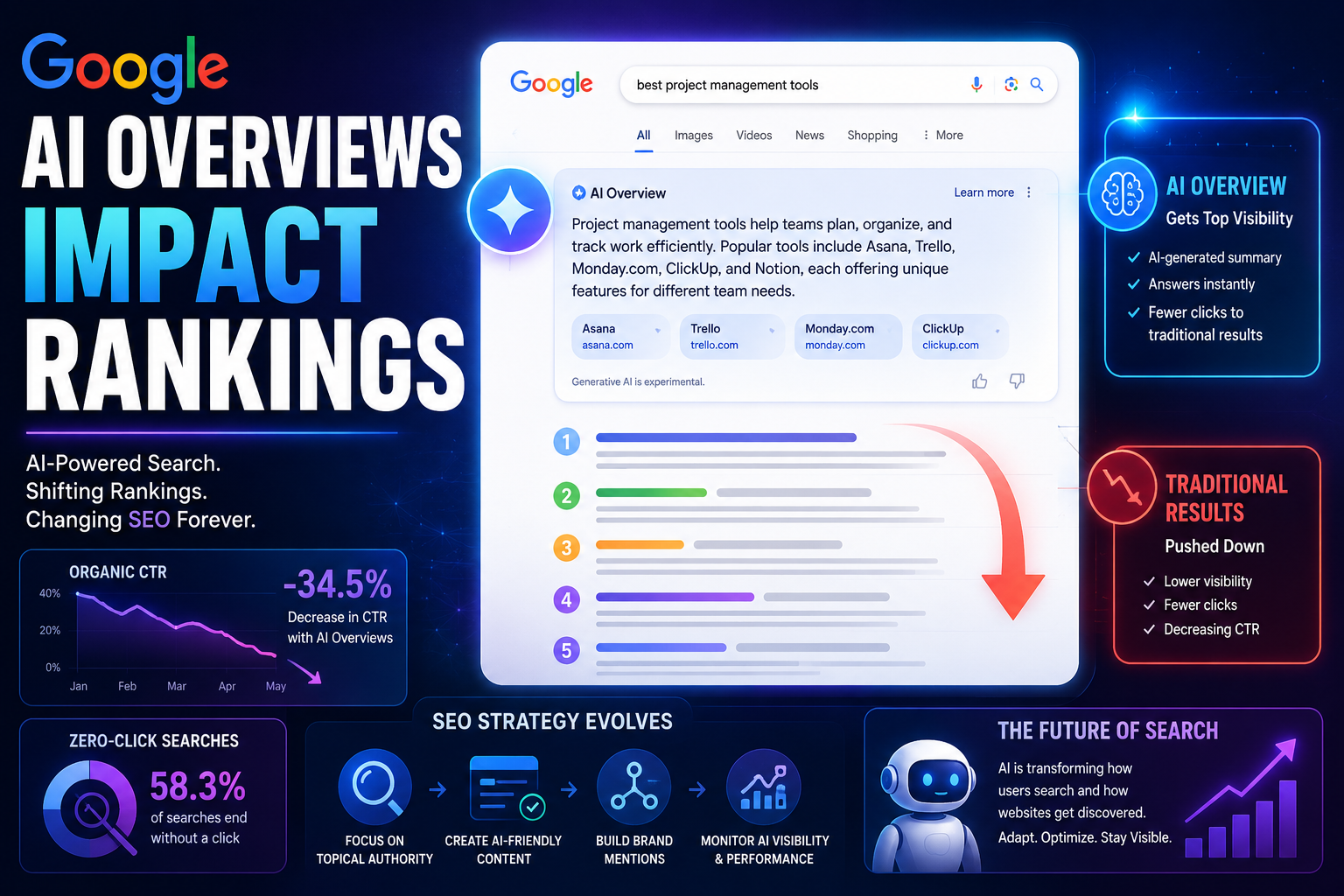
We have reached the next stage of Search. Thanks to Google AI Overviews (formerly known as the Search Generative Experience), Google is now not just sending users to web pages. It is now also providing answers to those questions on the search results page through AI-powered summaries. It has resulted in a shift in visibility, rankings, and traffic. SEO is not dead; it’s changing. Rather than just vying for position, brands now need to be trusted sources within the AI content.
A New Layer Above Traditional Search
For decades, the core of search results consulted was ads, featured snippets, and blue links. Positioning determined clicks. The closer to the top, the more clicks possible. The new AI Overviews hover over regular search results.
If Google decides that the answer to your question is complex, it crafts a summary explanation drawn from several sources. This may contain core insights, links to sources, and other queries. The impact is immediate.
It allows visitors to get their questions answered without having to click off the first page, and sometimes not at all. It does not eliminate rankings, but it does change the way they’re attained.
From Ranking #1 to Becoming “Part of the Answer”
Once upon a time, ranking first in organic search results was the pinnacle of SEO success. Now, it’s all about having the AI Overview feature on your page. Google now chooses several trusted websites to answer the query. A site can be ranked third or fourth, but if it’s mentioned in the AI summary, it gets the attention it would only get with a top position. On the other hand, a first-place rank can be undermined if the AI Overview meets the searcher’s needs. This changes the nature of SEO from “ranking for a position” to “ranking for authority”.
The Changing Relationship Between Rankings and Clicks
Click-through rates (CTRs) are one of the most apparent impacts of AI Overviews. The most significant impact is on informational queries. When users look for information such as definitions or how to do something, the AI answer may well provide an instant answer. But the effect of AI answers on traffic is not so straightforward.
While overall click volume may decrease for some searches, the remaining traffic is more relevant and likely to convert. Click-throughs from an AI Overview are likely to be looking for more detail, reviews, or solutions. This results in a trade-off in quality and volume. The overall traffic value could decline, but the value on the site could increase.
Authority Signals Are Stronger Than Ever
AI-generated summaries must be accurate and trustworthy. To maintain reliability, Google prioritizes sources that demonstrate strong authority signals.
Authority now extends beyond backlinks and domain strength. It includes brand reputation, topical expertise, author credibility, and consistent accuracy. Websites with established trust are more likely to be cited, referenced, and recommended by AI systems.
Shopify SEO experts in NYC emphasize the importance of building long-term authority over short-term ranking tactics.
Key authority signals that matter most now include:
- Demonstrated expertise and author credibility
- High-quality backlinks from reputable sites
- Strong brand recognition and mentions
- Accurate and regularly updated content
- Clear topic specialization and depth
Authority has shifted from a ranking advantage to a requirement for AI visibility.
Depth and Comprehensiveness Define Winning Content
AI Overviews are designed to answer complex questions quickly. To generate these answers, Google pulls from pages that provide comprehensive explanations rather than shallow summaries.
Content that performs well in this environment typically explores topics holistically. It anticipates follow-up questions, explains subtopics, and provides real value beyond basic definitions. Thin content written solely to target keywords struggles to compete.
Long-form content has gained renewed importance. Instead of multiple short articles targeting slight keyword variations, Google favors in-depth resources that cover entire subject areas. This approach allows AI systems to extract richer and more reliable information.
Conversational Search and Evolving User Intent
Search behavior is becoming increasingly conversational. Users now interact with search engines in a way that resembles dialogue. They ask detailed questions, refine them, and explore follow-up queries within the same session.
This evolution changes how content should be structured. Rather than focusing on isolated keywords, successful content mirrors the natural flow of conversation. It answers primary questions while also addressing related concerns and deeper considerations.
Effective content strategies now include:
- Question-driven headings and subheadings
- Clear explanations written in natural language
- Coverage of related and follow-up topics
- Logical progression from basic to advanced insights
By aligning with conversational search patterns, content becomes more likely to be used in AI-generated answers.
The Evolution of Keyword Strategy
Keywords remain important, but their role has shifted from rigid targeting to contextual understanding. AI systems interpret intent, relationships between topics, and the meaning behind queries rather than relying solely on exact keyword matches.
Modern SEO focuses on semantic relevance. Instead of optimizing a single page for a single keyword, content should cover a topic comprehensively, using related terms, synonyms, and natural phrasing.
Amazon listing optimization in Manhattan encourages content creators to prioritize clarity and usefulness over algorithmic manipulation.
Brand Visibility Without the Click
AI Overviews introduce a powerful new form of exposure: brand mentions within answers. Even when users do not click a link, they still see the sources cited in the AI summary.
This creates a new type of visibility similar to traditional media exposure. Being mentioned alongside authoritative sources builds credibility and familiarity. Over time, this can lead to increased brand searches, direct traffic, and customer trust.
SEO success is no longer measured only by clicks. Visibility, recognition, and authority are becoming equally important outcomes.
The Decline of Low-Value Content
The rise of AI Overviews accelerates the decline of content created purely for search rankings. Pages that provide little original value, repeat common knowledge, or rely heavily on automation struggle to gain visibility.
Google’s AI systems are designed to identify depth, expertise, and usefulness. As a result, the gap between high-quality and low-quality content continues to widen.
Content most at risk includes:
- Thin or repetitive articles
- Keyword-stuffed pages
- Generic rewritten content
- Clickbait headlines without substance
- Low-value affiliate pages
The focus has shifted from producing more content to producing better content.
Helpful Content as the Foundation of Modern SEO
Google has consistently emphasized helpful, people-first content. AI Overviews make this philosophy central to search visibility.
Helpful content solves real problems, demonstrates expertise, and provides unique insights. It often includes examples, explanations, and perspectives that cannot be easily replicated.
The most successful websites are those that prioritize user value over algorithmic shortcuts.
Measuring Success in the AI Search Era
As search evolves, so do performance metrics. Traditional metrics such as page views and keyword rankings remain relevant but no longer tell the full story.
Modern SEO performance includes broader visibility signals:
- Frequency of citations in AI answers
- Growth in branded search queries
- Engagement and conversion rates
- Visibility across multiple search features
These metrics reflect a more holistic understanding of how users discover and trust brands.
Adapting SEO Strategy for the Future
Businesses that adapt early will benefit most from the AI transformation. The focus must shift from chasing rankings to building authority, trust, and comprehensive resources.
Key strategic priorities include:
- Creating in-depth, topic-focused content
- Building strong brand authority and reputation
- Structuring content for clarity and readability
- Addressing real user questions and concerns
- Maintaining accuracy and regular updates
- Prioritizing quality over content volume
Digital Marketing Services is evolving into a discipline centered on trust, expertise, and long-term value.
The Future of Search Is Hybrid
Search is no longer limited to traditional listings. It has become a hybrid ecosystem that combines AI summaries, organic results, multimedia content, and interactive features.
This transformation does not eliminate SEO; it elevates it. Websites that embrace depth, credibility, and user-focused content will continue to thrive in this new environment.
AI Overviews represent the next stage of search evolution—one that rewards expertise, authority, and meaningful content more than ever before.
FAQs
1. Will AI Overviews replace traditional SEO?
No. SEO remains essential, but its focus has expanded. Rankings still matter, yet being cited in AI answers is becoming equally important.
2. Why is my traffic dropping after AI Overviews launched?
Some informational queries now receive answers directly on the results page. However, remaining traffic is often more qualified and conversion-focused.
3. How can I get featured in AI Overviews?
Create authoritative, well-structured, and comprehensive content that clearly answers user questions and demonstrates expertise.
4. Are keywords still relevant?
Yes, but modern SEO emphasizes topics, intent, and natural language rather than exact keyword repetition.
5. What type of content performs best now?
In-depth, helpful, experience-driven content that solves real problems and answers related questions comprehensively.
6. Is link building still important?
Yes. High-quality backlinks remain a strong signal of authority and trust.
7. Should businesses change how they measure SEO success?
Yes. In addition to traffic and rankings, businesses should track brand visibility, engagement, and AI citation presence.
8. Is AI search bad for small websites?
Not necessarily. Smaller sites with strong expertise and high-quality content can still be cited and gain visibility.
9. Will AI Overviews affect all industries equally?
No. Informational and research-based industries will experience the biggest changes, while transactional searches remain more stable.
10. What is the most important SEO strategy moving forward?
Focus on trust, authority, and creating content that genuinely helps users.