
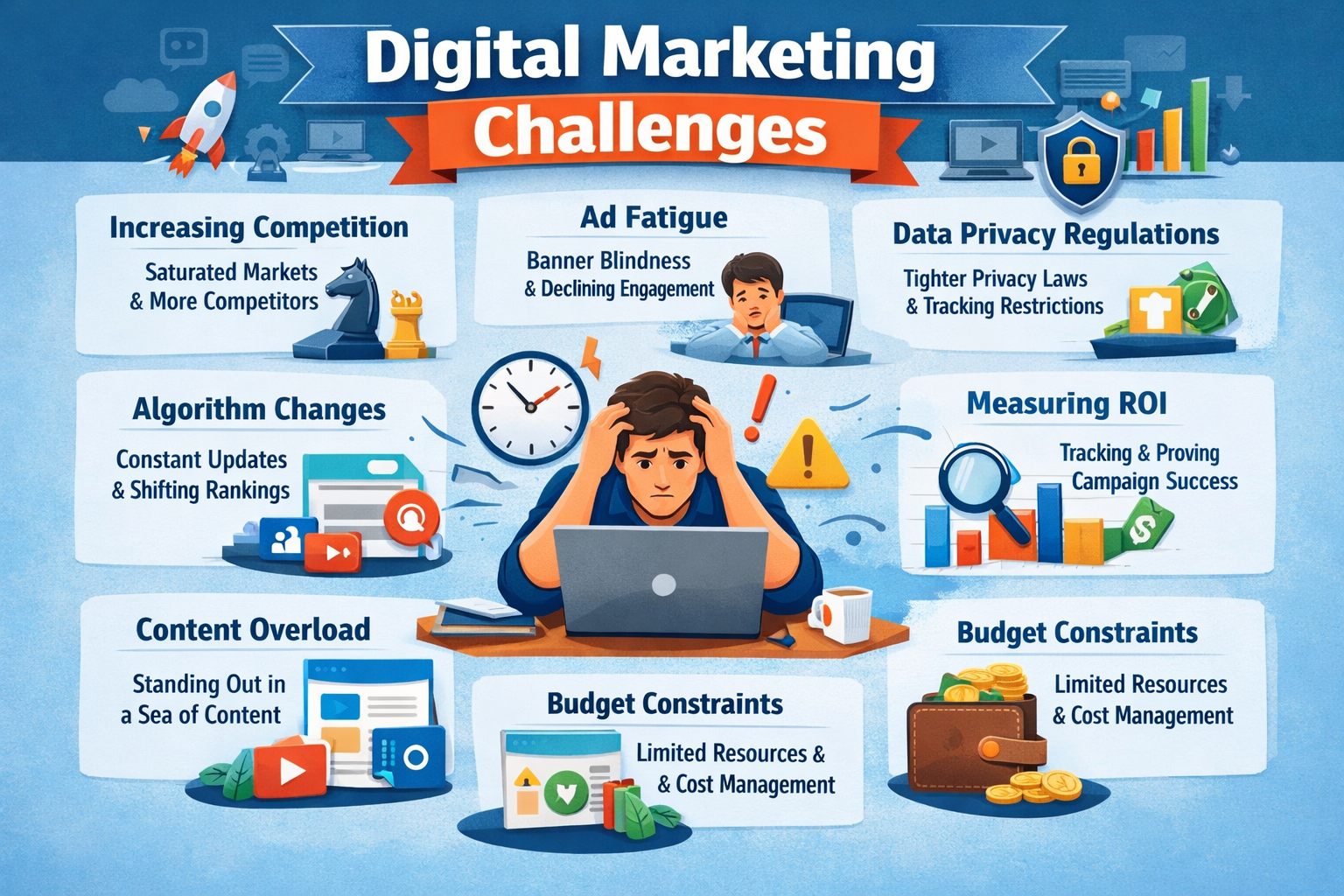
There is an unparalleled pace of transformation in digital marketing. It implies that 2026 brands will inevitably shift away from traditional ways of doing things and become smarter, data-driven, and consumer-oriented. The inability of some companies to keep up with changes in consumer behavior will undermine their competitiveness due to new legal rules and technologies in the field of artificial intelligence.
Companies must now have combined, information-driven approaches that aren’t overly reliant on technology, but also lack artificiality. Long-term success will depend on the owners of the privacy issue and on the growing competition in matching marketing activities to observable business results.
Key Encounters in Digital Marketing for 2026
Data Privacy, Compliance, and Trust
Digital Marketing Services on a global scale is also undergoing a transformation due to the global regulations on data privacy. Higher compliance restrictions put a barrier on the accessibility to third-party tracking data and hinder the audience targeting.
Key challenges include:
- Reduced access to third-party cookies
- Greater scrutiny over consent management
- Increased compliance costs
- Heightened consumer concerns about data misuse
Customers are becoming well informed on the manner in which their data is gathered and utilized. Trust has turned out to be a competitive differentiator. The brands need to shift out of the transactional data collection to value-based to provide a transparent relationship.
The Decline of Third-Party Cookies
Some of the most significant areas losing as a result of the loss of the third-party cookies would be retargeting, attribution modelling, and audience segmentation. The performance marketing strategies which depended on behavioral monitoring heavily will need to change.
Without third-party tracking, marketers face:
- Limited cross-platform user tracking
- Reduced precision in remarketing campaigns
- Attribution model inaccuracies
- Increased dependence on platform-reported data
This shift forces businesses to rethink measurement frameworks and invest in owned data ecosystems.
AI-Generated Content Saturation
Artificial intelligence has democratized content creation. While AI improves efficiency and scalability, it has also led to content saturation across digital platforms.
As a result:
- Audiences are exposed to repetitive, low-differentiation content
- Organic engagement rates are declining
- Brand authenticity is harder to maintain
- Trust in digital messaging is increasingly fragile
In 2026, competitive advantage will come from strategic storytelling, unique positioning, and human-centered creativity—not volume alone.
Rising Customer Acquisition Costs (CAC)
Digital advertising costs continue to increase across search, social, and display platforms. Competition is intensifying, especially in saturated industries.
Key contributing factors:
- More advertisers entering digital channels
- Algorithmic bid competition
- Reduced targeting accuracy
- Shorter consumer attention spans
To remain profitable, businesses must shift focus from pure acquisition to customer lifetime value optimization.
Platform Dependency Risks
Many brands rely heavily on social platforms for visibility and sales. However, algorithm updates, policy changes, or platform instability can disrupt traffic and revenue overnight.
Overdependence on a single channel creates:
- Revenue volatility
- Reduced brand control
- Lower long-term sustainability
Diversification and owned media strategies are essential to mitigate this risk.
Measurement and Attribution Complexity
The fragmentation of user journeys across devices and platforms makes accurate attribution increasingly difficult.
Challenges include:
- Multi-device tracking limitations
- Walled garden ecosystems
- Reduced data sharing between platforms
- Misalignment between marketing metrics and business outcomes
Organizations must move beyond last-click attribution and adopt advanced measurement models aligned with revenue impact.
Key Focus Areas for Digital Marketing Strategy in 2026
1. First-Party and Zero-Party Data Strategy
First-party data—collected directly from customers—will be the foundation of effective digital marketing in 2026. Zero-party data, voluntarily shared by consumers, will be even more valuable.
Strategic priorities include:
- Building robust CRM systems
- Encouraging account creation and loyalty enrollment
- Implementing preference centers
- Creating value exchanges for data sharing
Organizations that successfully develop strong data ecosystems will gain better personalization capabilities and improved targeting accuracy.
2. Ethical and Intelligent AI Integration
Artificial intelligence will move from being a tactical tool to a strategic enabler. Its primary roles will include predictive analytics, customer journey optimization, dynamic pricing, and automated campaign management.
However, responsible implementation is critical.
Key considerations:
- Human oversight in content creation
- Transparent AI usage policies
- Avoiding over-automation of customer interactions
- Maintaining brand voice consistency
AI should enhance strategic thinking—not replace it.
3. Personalization at Scale
Consumers now expect highly relevant experiences tailored to their preferences and behavior. Generic messaging is increasingly ineffective.
Advanced personalization strategies will include:
- Behavior-based email automation
- Dynamic website content
- AI-powered product recommendations
- Customized ad creatives
The goal is to deliver relevance without compromising privacy or creating intrusive experiences.
4. Omnichannel Integration
Customer journeys are no longer linear. Consumers interact with brands across websites, social platforms, email, mobile apps, and offline channels.
An effective omnichannel strategy requires:
- Unified customer data platforms
- Cross-channel messaging consistency
- Integrated marketing automation systems
- Seamless handoffs between digital and physical experiences
Consistency builds familiarity, and familiarity builds trust.
5. Content Authority and Thought Leadership
In an era of content overload, authority becomes a competitive advantage. Brands must position themselves as credible industry leaders rather than content producers.
Focus areas:
- Research-driven content
- Long-form educational resources
- Expert-led webinars and podcasts
- Data-backed case studies
Quality and credibility will outperform volume.
6. Community-Centric Marketing
Building communities around shared values and interests will become more powerful than traditional audience targeting.
Community strategies include:
- Exclusive membership programs
- Private online groups
- Brand ambassador initiatives
- Interactive live sessions
Community fosters loyalty, advocacy, and organic growth—reducing reliance on paid acquisition.
7. Video and Interactive Media Dominance
Short-form video, interactive experiences, and immersive content will continue to drive engagement.
Emerging formats include:
- Live commerce
- Interactive polls and quizzes
- Shoppable video experiences
- Augmented reality previews
Brands must experiment with formats that combine entertainment and utility.
8. Conversion Rate Optimization (CRO) and User Experience
Traffic generation alone is no longer sufficient. Maximizing conversion from existing traffic will be a major strategic focus.
CRO strategies include:
- A/B testing landing pages
- Simplifying checkout processes
- Reducing page load times
- Optimizing mobile usability
Incremental improvements in user experience can significantly impact revenue.
Artificial Intelligence and Strategic Automation
Artificial intelligence has transitioned from experimental adoption to operational necessity. Predictive analytics, intelligent segmentation, and automated campaign optimization are now embedded within modern marketing workflows. Yet, excessive automation without human oversight risks diluting brand authenticity. Successful Digital marketing for fashion retailers in NYC integrate AI as a strategic enhancer rather than a substitute for creative thinking.
Personalization as a Standard Expectation
Personalization is no longer a competitive advantage; it is a baseline expectation. Consumers anticipate tailored product recommendations, relevant email communications, and contextual digital experiences. Generic messaging often leads to disengagement and reduced trust. Advanced personalization strategies rely on behavioral data, predictive modeling, and real-time content adaptation.
Omnichannel Integration and Journey Consistency
The contemporary customer journey spans multiple platforms, devices, and touchpoints. A consumer may discover a product through social media, research it via search engines, compare reviews on third-party platforms, and finalize the purchase through a mobile application. Inconsistent messaging across these touchpoints can erode trust and reduce conversion rates. An integrated omnichannel strategy ensures cohesive communication and seamless transitions between channels.
The Economics of Customer Retention
Rising acquisition costs have intensified the importance of retention marketing. Acquiring new customers often demands significantly higher investment compared to nurturing existing relationships. Organizations are increasingly prioritizing loyalty initiatives, subscription models, and personalized post-purchase communication.
Customer lifetime value has become a central metric guiding strategic decisions. Retention efforts that deliver consistent engagement and ongoing value contribute to predictable revenue streams.
Strategic Recommendations for 2026
To remain competitive, organizations should:
- Invest in first-party data infrastructure.
- Integrate AI responsibly with clear governance policies.
- Diversify traffic sources and strengthen owned channels.
- Prioritize retention and lifetime value metrics.
- Align marketing KPIs directly with revenue outcomes.
- Build brand authority through high-quality, research-driven content.
- Develop community ecosystems to reduce platform dependency.
Digital marketing for real estate firms in New York will reward brands that combine analytical rigor with human insight.
FAQs
What will be the biggest digital marketing challenge in 2026?
The most significant challenge in 2026 will be balancing personalization with data privacy. As regulations become stricter and third-party data becomes less accessible, marketers must rely heavily on first-party data while maintaining transparency and compliance. At the same time, consumers expect highly personalized experiences.
How should businesses prepare for a cookieless marketing environment?
Businesses must shift toward first-party and zero-party data collection strategies. This includes strengthening CRM systems, encouraging user registrations, implementing loyalty programs, and creating meaningful value exchanges that motivate customers to share information voluntarily. Companies should also invest in contextual advertising and advanced analytics models that do not rely solely on cross-site tracking.
Is artificial intelligence replacing human marketers in 2026?
Artificial intelligence is transforming digital marketing, but it is not replacing human marketers. Instead, AI enhances efficiency through automation, predictive analytics, and optimization tools. Strategic planning, creative storytelling, ethical oversight, and brand positioning remain human-driven responsibilities.
Why is customer retention more important than acquisition in 2026?
Customer acquisition costs continue to rise due to increased competition and advertising saturation. Retaining existing customers is generally more cost-effective and contributes directly to higher customer lifetime value. Loyal customers also generate referrals and repeat purchases, which reduce dependency on paid advertising.
What role does content marketing play in 2026?
Content marketing remains a core pillar of digital strategy, but the emphasis has shifted toward authority and depth. With the proliferation of AI-generated material, audiences prioritize credible, research-driven, and insightful content. Brands must focus on producing high-quality educational resources, thought leadership pieces, and data-backed insights that differentiate them from competitors.