Advertising online is no longer optional—it’s essential. Many businesses face a critical decision between implementing social ads or Google ads. Moving forward to 2025, your business success depends heavily on understanding the strengths and strategies employed by Social Ads vs Google Ads. These powerful advertising channels operate differently to meet separate business targets for different user actions. Your selection depends on industry type, mission, target audience, and success benchmarks.
Which is better Google Ads or Social Media Ads
Understanding the Core Differences
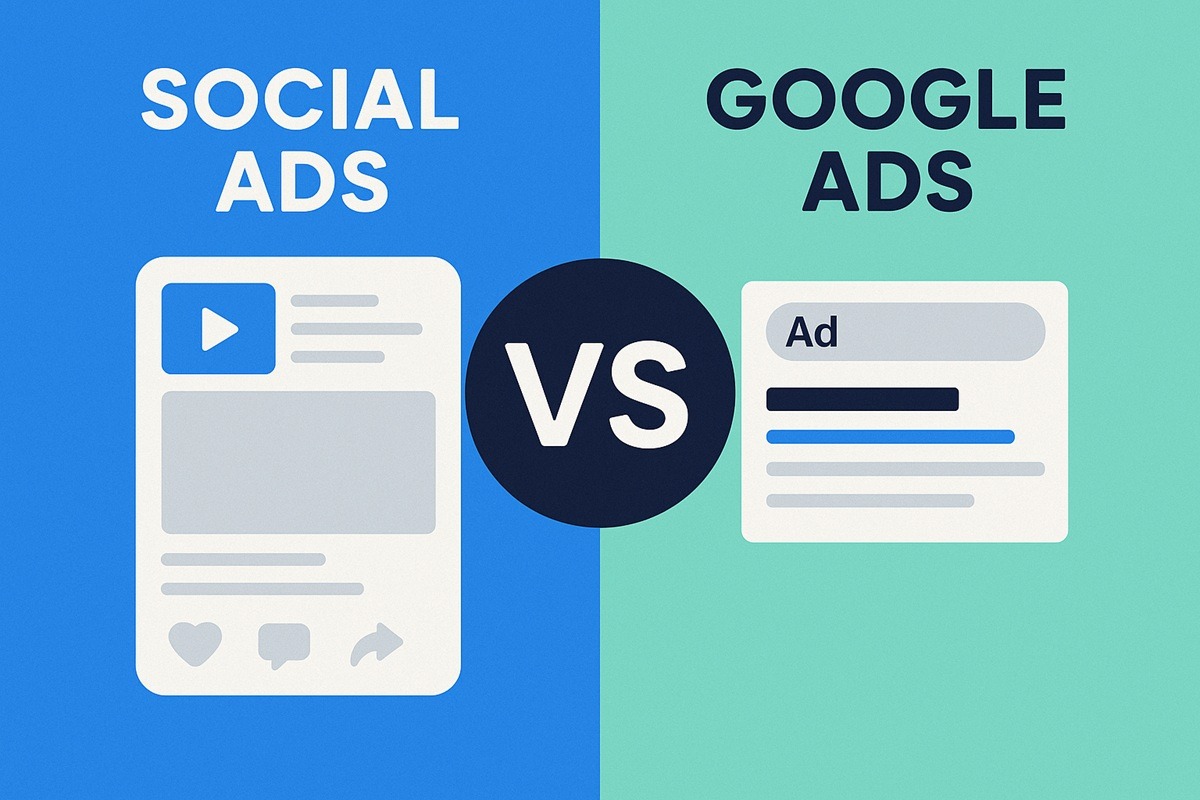
The basic operating principles of Google Ads and social media advertisements remain distinct. Search engine advertising, such as Google Ads or pay-per-click (PPC), presents ads to users who actively search for products or services. They respond to intent. Internet users who type “best noise-canceling headphones” must be precisely matched by Google ads because they serve search-specific content through keyword analysis.
Next to Google Ads lie social ads, which operate through Facebook, Instagram, TikTok, and LinkedIn by targeting users based on their behavior and personal attributes. These advertisements appear during user interface scrolling occasions that do not require a purchasing desire. These ads interrupt viewers with creative and engaging content to capture their attention.
Targeting in 2025: Advanced, Yet Different
Both Google and social media platforms demonstrate enhanced targeting features until 2025. Google Ads achieves its best predictions of consumer intent ever through artificial intelligence that analyzes search behaviors, shopping trends, and voice search insights. Through this platform, online businesses can target customers precisely when they need solutions.
Lookalike audiences created by AI play a dominant role in social ads, while the technology also utilizes deep behavioral insights and sentiment analysis to pinpoint the best customers. Through machine learning algorithms, Meta platforms (Facebook and Instagram) and TikTok present advertising content to users with the highest probability of interacting regardless of their explicit product searches. Social advertising stands out because it excels at demand creation instead of a limited focus on demand acquisition.
Cost Considerations: Which One Offers Better Value?
Cost per click (CPC) and cost per acquisition (CPA) are vital metrics in deciding which platform offers better value. As of 2025, Google Ads tend to have a higher CPC, especially in competitive industries like law, finance, or real estate. Because users on Google have higher intent, businesses often pay more for that immediate conversion potential.
Social ads generally offer a lower CPC and can reach broader audiences with smaller budgets. However, the trade-off is that these users may not be actively shopping, requiring more nurturing before conversion. The decision ultimately comes down to your goals. If your priority is immediate sales or lead generation, Google might justify the higher cost. If you aim to build brand awareness, drive website traffic, or grow a following, social ads offer more cost-efficient reach.
Creative Strategy: Search vs Visual Appeal
Another significant distinction lies in how your ads are presented. Google Ads rely on concise, keyword-optimized text and compelling headlines. These are usually accompanied by extensions such as phone numbers, links to site pages, or store locations. The visual aspect is limited unless you run Google Display or Shopping campaigns.
In contrast, social ads thrive on visuals. Whether it’s a video, carousel, image, or story, these platforms reward visually compelling content that grabs attention in a scroll-heavy environment. The creative freedom allows for storytelling, humor, and emotion, making it an excellent fit for lifestyle brands or businesses with strong visual elements.
In 2025, short-form videos will dominate on platforms like TikTok and Instagram Reels. Brands that invest in high-quality visuals and creative storytelling on social media often see stronger engagement and shareability, increasing organic reach alongside paid performance.
Conversion Tracking and Data Insights
Paid social vs paid search offer detailed analytics, but how data is interpreted and acted upon differs. Google Ads gives clear attribution paths—users click, convert, and make a purchase. It’s easier to measure direct ROI and connect spending to results. By integrating tools like Google Analytics 4 and advanced attribution modeling, marketers in 2025 can get granular with user journeys.
Social media platforms have improved tracking, but iOS privacy updates and third-party cookie limitations still impact data precision. Meta and other platforms have invested in solutions like aggregated event measurement and server-side tracking to improve data quality. Still, regarding direct sales attribution, Google remains more straightforward.
Online advertising platforms comparison provides richer insights for gauging engagement, awareness, and community growth. Metrics like engagement rate, shares, saves, and comments reveal how people feel about your brand, not just whether they clicked a button.
Suitability by Business Type
Different business types naturally gravitate toward one platform over the other. Local service providers—like plumbers, dentists, or legal professionals—tend to perform better with Google Ads due to their clients’ clear, immediate needs. When someone needs a service fast, they search Google.
E-commerce brands, lifestyle products, and digital courses often thrive on social ads, where they can showcase their offerings visually, run retargeting campaigns, and build a loyal community. In 2025, influencer integration has become a key component of social ad success. Brands often combine paid social campaigns with influencer-generated content to maximize credibility and conversion.
For B2B companies, the choice becomes even more nuanced. Google Ads effectively target industry-specific search terms and generate leads via whitepapers, demos, or consultations. However, LinkedIn Ads, a type of social ad, can be highly effective in reaching decision-makers in specific industries and job roles, making it a valuable companion to Google.
Funnel Placement: Where They Fit In Your Strategy
One of the best ways to think about Google Ads and social ads is in terms of the marketing funnel. Google Ads are bottom-of-the-funnel tools—they capture high-intent users ready to act. They work best when you have a product-market fit and want conversions.
Social ads are more versatile across the funnel. They’re excellent for top-of-funnel goals like awareness and interest. They help introduce your brand to cold audiences. However, when paired with retargeting ads, they also shine in mid-funnel efforts, reminding users who’ve engaged before to come back and convert.
In Digital advertising strategy 2025, the most successful businesses are not choosing between Google and social media—they are using both strategically. A well-integrated campaign might start with eye-catching social ads to introduce your brand, followed by Google search ads to capture users when they’re ready to buy.
The Role of AI and Automation
AI is no longer a buzzword—it’s a driving force behind ad performance in 2025. Google Ads now heavily rely on Performance Max campaigns, which automate targeting, bidding, and creativity across all Google properties. Advertisers can now focus more on creative strategy while Google optimizes delivery.
Social platforms use AI for dynamic creative optimization, showing different ad versions to different people based on engagement history and preferences. TikTok, Meta, and Snapchat allow auto-generated variations of your ads tailored to different segments, making testing faster and more effective.
While automation simplifies ad management, trust in the algorithm is required. Businesses must ensure they feed the system with enough high-quality input, such as strong creative assets or clear conversion goals.
Final Verdict: Which Is Better in 2025?
Choosing between Google and social ads is that it depends. If your business thrives on immediate, high-intent traffic and needs measurable, fast ROI, Google Ads might be your best investment. If you’re launching a new brand, expanding into new markets, or want to build emotional connections with your audience, social ads could deliver better value.
In 2025, the smartest marketers will blend both platforms. They will use social ads to generate interest and Google Ads to capture conversions. Rather than picking one over the other, the goal is to understand how each platform contributes to your customer journey and allocate your budget where it will have the most impact.
The digital advertising world is more sophisticated than ever, and success lies in leveraging the strengths of each channel. Whether you’re a startup with limited funds or a seasoned enterprise scaling globally, the key is not choosing between social and search—but understanding how to make them work together.
Frequently Asked Questions (FAQs)
1. Which is more cost-effective: Google Ads or Social Ads?
It depends on your industry and goals. Google Ads typically cost more per click due to high user intent, while social ads usually have a lower cost and are more suitable for brand awareness and engagement campaigns.
2. Can I use both Google Ads and Social Ads simultaneously?
Yes, many successful businesses use both simultaneously. Social ads create awareness and nurture leads well, while Google Ads are ideal for capturing high-intent users ready to take action.
3. Which platform is better for e-commerce businesses?
Social ads often perform well for e-commerce because of their visual format and targeting capabilities. However, combining them with Google Shopping ads can help capture discovery and purchase intent.
4. Do Google Ads or Social Ads provide better ROI?
Google Ads offer better ROI for direct conversions, especially in service-based industries. Social Ads, however, often deliver strong ROI over time by building brand loyalty and increasing lifetime customer value.
5. How important is ad creativity in Google Ads vs. Social Ads?
Creativity is much larger in social ads, where visuals and storytelling drive engagement. In Google Ads, ad copy and keyword strategy are more critical for performance.